









“Three cohorts ago, I started on the Monday of Outdoor Week. First day on the job, no office time, just straight in. I don’t think I know what our office looked like that first week, I just showed up. But it was just so fun.”
That was Jude Ornburn from the Missouri Botanical Garden (MOBOT), on her first experience working with the Eco-Act program in 2022. Eco-Act is a part science class, part teaching training, part fi
eld trip extravaganza led by MOBOT and our very own Latin and Restorative/Environmental Justice teacher Matthew Tuths.
Traci Moore, creative director at UMSL’s marketing department, was a participant in the UCity branch of the Eco-Act program in the 1987-88 school year. As a member of one of the first cohorts, Moore’s time in the program left a lasting positive impact on her life going forward.
“Out of my four years of high school, Eco-Act was one of my top three classes,” Moore said. “And I really did love school; I loved all my classes, and I’m not a science person—Eco-Act was still one of my favorite classes.”
The program is designed to enrich the lives of Eco-Actors not just for a grade or a credit, but with real tangible life experiences particularly linked to environmental work. Eco-Act coordinator Jo Hill has been working with this program for four years, and has very distinct goals for its purpose.
“The goal of Eco-Act really broadly is to cultivate environmental lea
ders,” Hill said. “So, I think Eco-Act is really cool and unique in the way we approach that because we approach it in multiple different angles. Instead of just doing environmental research, we’re doing environmental research, we’re making you guys go and teach fourth graders, which is a totally different skillset, and we’re also exploring the outdoors and getting more comfortable and more confident in nature. That’s broadly the goal, is to cultivate the next generation of environmental leaders. And then we break that down into three things, we say: effective educators, knowledgeable ecologists, and innovative leaders.”
One of the angles that the program takes is having the participants learn to teach fourth grade students about ecology in a nearby elementary school. The vast majority of other similar programs countrywide do not offer this, and learning to teach carries over into many valuable skills later on. Hill especially values the importance o
f being able to communicate with different audiences.
“I think that one of the elements of a good environmental leader is being able to communicate with a lot of different types of audiences,” Hill said, “and I think that that’s something that the fourth grade teaching is really good at building your skills for because it’s so different. You have to think about it in a completely different way than you would if you were talking to your peers. There’s kind of a dual thing going on where the high school students are sharpening those communication skills and then at the same time we are getting the fourth graders, hopefully, to think about and maybe even care about the environment.”
Moore primarily works with college students, but her experience teaching fourth graders in Eco-Act still helped her greatly.
“I will say that I believe that the Eco-Ac
t teaching helped me,” Moore said. “Even though it’s a very big age difference between my students then and college students, it was really helpful.”
Senior Makayla Jamison has experience speaking in front of an audience in theater, and she fit well in the teaching section of the program.
“Honestly, it’s not that different,” Jamison said, “because I’m in theater and I would speak in front of an entire audience of people so it’s not that hard to teach in front of a smaller scale of people.”
One of the biggest parts of the program’s goals is bringing people together and enhancing communication skills. The teaching portion is a great example of this, but so are Eco-Act’s frequent outings and field trips. Senior and current Eco-Actor Wendy Zhang enjoys the ability to interact with people that are also in the program during these trips.
“My favorite is definitely just bonding with people, talking, making friends and having to be by ourselves in nature without parents or anyone like that really,” Zhang said.
The Eco-Act program does many field trips and outings for team bu
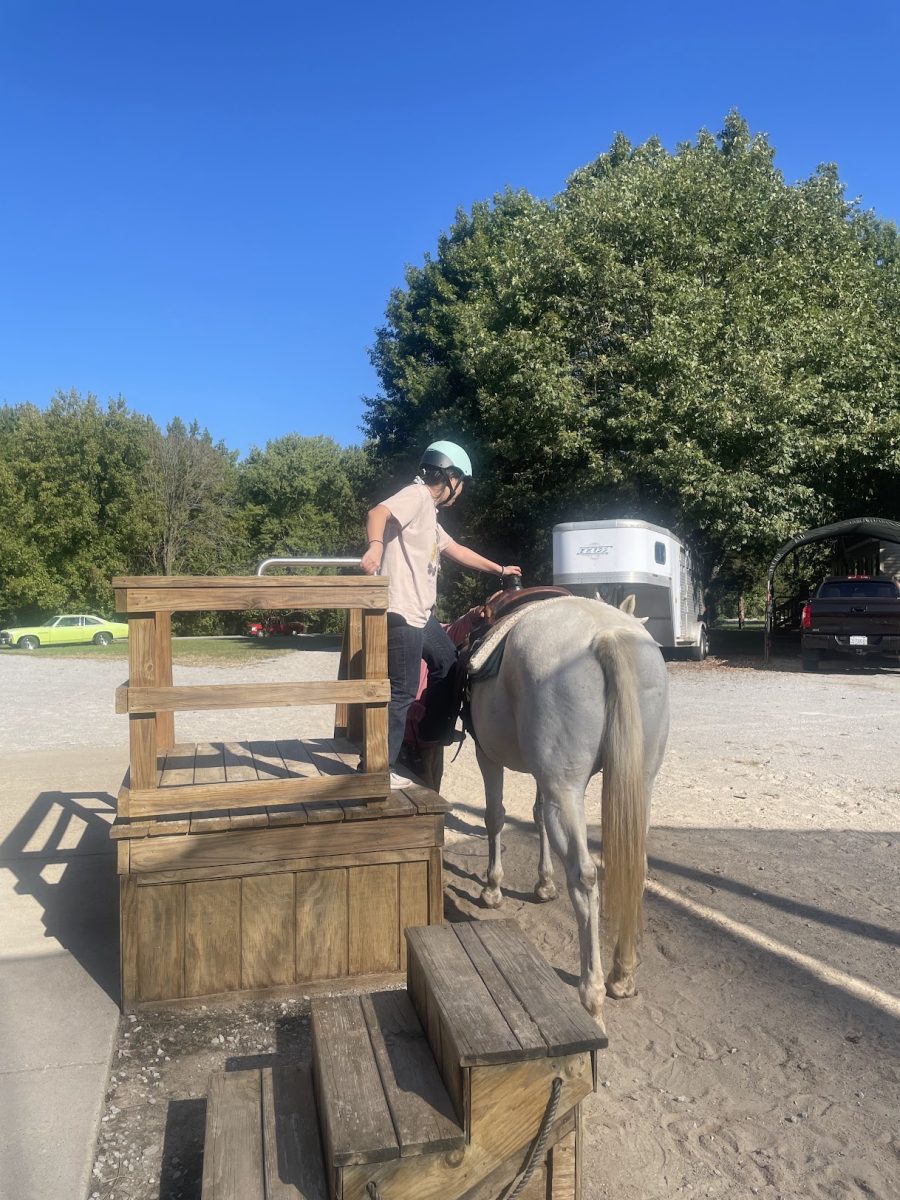
ilding, educational purposes and giving memorable experiences to participants. This year, this includes a caving trip, biking on a trail, horseback riding and many others that have
happened and will in the rest of the year.
“My favorite was definitely the river,” Zhang said. “You can see bugs, you can see fish, we even got to see crawdads in there. That was really interesting.”
Some field trips, like the Green’s Cave trip, include new experiences designed to push Eco-Actors’ comfort zones.
“Our Green’s Cave trip is definitely physically difficult,” Hill said, “because it’s a three mile hike out to the top of a bluff, and it’s not on trail so you’re kind of fighting your way through the forest. But then there’s an abandoned bootlegger’s car from the 1930’s that’s on the path. It’s a really cool hike, and then when you get out there, you rappel 100 feet down the bluff into the mouth of a cave and it’s just a very unique experience. It’s not really something that you can do
as just a general member of the public so I think it’s really cool.”
During the summer, one of the first things an Eco-Actor can do is a four day long overnight camping trip, based around touring many nearby Missouri ecosystems and getting to know the program. Jamison particularly enjoyed the overnight stay portion of Outdoor Week.
“My favorite part of Outdoor Week had to be when we had the cabins, because that was really fun,” Jamison said. “We basically had a huge sleepover. Actually, that whole week wa
s a sleepover but the cabins were the best part.”
Ornburn appreciates the life experience trips like Outdoor Week can give to students that live in urban environments.
“To see kids who have never left the city or been in the outdoors go fr
om scared to be around bugs to totally comfortable and sitting around the campfire three days in,” Ornburn said, “it’s amazing in that short period of time.”
And with the amount of progress made in such a short time, the change in mindset and perspective after the entire program can really be astounding. During her time in the program, Moore’s view on ecology and our planet changed drastically.
“I just never really thought about ecology,” Moore said. “So I think that my view of things that we do, as humans, to the planet changed. It changed my view of how we treat the planet.”
Eco-Act also has a section of the program focused around helping the planet and our school community. These environmental projects are worked on through the whole year and leave lasting, tangible impacts on our school and area.
“A group of students went into their freshman science classrooms and tau
ght them how to recycle properly, basically,” Ornburn said. “So it’s like an ongoing thing that they’re tackling at the start before it can get that far so people aren’t contaminating the recycling. Their project ended up winning an award from Missouri Coalition of the Environment which was really cool.”
Whatever the environmental project is, doing it not only helps our community but also teaches participants many skills they need for living adult life after high school.
“So, I think Eco-Act students sometimes don’t realize how many hidden learning components there are in the environmental project because it’s not just learning how to carry out resea
rch,” Hill said, “it’s also things that you might not think about like how to write a professional email, or how to set up an interview with somebody, or, we haven’t gotten to this yet, but we’ll do presentations and that’s a whole other skillset too, just getting comfortable in front of an audience. As well as making sure you’re staying on top of your deadlines and checking your email and all of those professional skills like that. Obviously there’s an ecology and environmental learning component of it because each group gets really knowledgeable about the topic that they’re doing, but I would say, arguably, just as important is all of those skills that you have to work on and build in order to have a successful project.”
The skills gained from the environmental projects, and the program as a whole, transfer into skills for any and every field, no matter what Eco-Act alumni may do afterwards. Hill hopes that people goi
ng into other fields will take the care for the environment that they gained in the program into their future jobs.
“There’s a good number of kids who go into environmental careers or natural resources management or something like that,” Hill said. “We have a good group of students who go into teaching. And then there’s a group of students who do something completely different, but the hope is that even if you’re not becoming an environmental educator, strictly as your job title, that you’re still taking these lessons and this experience with you no matter what job you go on to. Because it’s really important to have people who care about the environment spread throughout lots of different careers.”
Our planet is something that should be cherished, and must be taken care of if we are to live well on it. The Eco-Act program is designed to be a stepping stone to help students aid in that goal.
“In the environmental field, there’re a lot of jobs, and the environment is kind of messed up so there’re going to continue to be a lot of jobs,” Hill said.
So, if you are a current Sophomore or Junior and want to work in an
environmental career, teach about ecology, make environmental change in your school, just get a science credit or have fun on field trips with friends, this is the class for you! Talk
to your counselor about becoming an Eco-Actor at your next schedule meeting.